During a meeting, a direct report outside of VP1’s organization shows visible frustration. The reaction is about a topic important to that senior leader. What happens next?
Reaction A: VP1 escalates the perceived frustration to the CEO, triggering a cascade of communication across multiple leadership levels. The message passes through the CEO, VP2, and Director1 before finally reaching the direct report. This indirect process is inefficient, dilutes context, and prolongs resolution.
Reaction B: VP1 directly addresses the indirect report during the meeting, sharing their perception and asking about the observed frustration. The direct report provides additional context, clarifying the situation. VP1 uses this understanding to coach the individual on alternative communication strategies. This resolves the issue efficiently while fostering trust. It also encourages professional growth.
Cost of Reactions
Beyond the immediate operational advantages. Choosing direct communication methods like Reaction B over indirect methods such as Reaction A has clear financial implications. This is demonstrated below. A difference of $375.00.
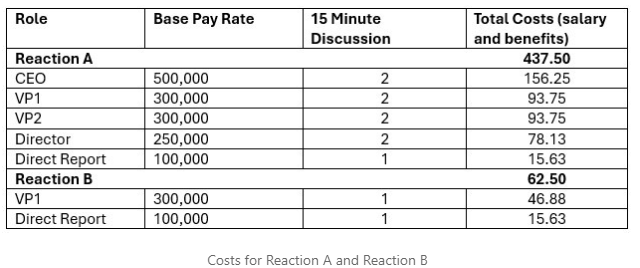
The Hidden Costs of Indirect Feedback
Is your organization unknowingly spending $375.00 on a single interaction like this? How often do these scenarios play out in your workplace? Beyond the example above, indirect communication can lead to:
· Repeated inefficiencies from unresolved behaviors.
· Loss of critical insights buried in frustration or miscommunication.
· Missed opportunities to address innovative ideas hidden in emotional reactions.
· Broken trust
If this behavior occurs once daily across your organization, the cost balloons to $108,361.20 annually. Imagine redirecting this money into interventions that foster a culture of direct, respectful feedback.
Investing in Direct Feedback-Rich Cultures
This $108,361.20 could fund:
· Leadership training to equip managers with essential feedback skills.
· Cultural initiatives which encourage open and respectful communication.
· Systems to encourage and coach leaders to demonstrate direct feedback behaviors.
By addressing just one behavior and its broader implications, the potential ROI for fostering direct feedback becomes undeniable.
A Business Imperative
Creating a culture of direct, respectful feedback isn’t just a leadership ideal, it’s a business necessity. The costs of indirect communication are tangible and steep, while the benefits of honest dialogue extend far beyond cost savings. Such cultures foster:
· Better decision-making.
· Stronger, more cohesive teams.
· Higher levels of trust in leadership.
· A more agile and resilient organization.
Option B is more than a single solution; it’s a behavioral blueprint for defining workplace communication. It sets a standard that reduces bureaucracy, uncovers untapped potential, and empowers everyone to communicate with clarity and respect.
The Choice is Yours
Will your organization allow inefficiencies and misunderstandings to erode its value? Or will it invest in creating a culture where behaviors like direct feedback become the norm, saving costs, streamlining operations, and building the trust that fuels innovation?
By championing this approach, you don’t only thrive financially, you create a workplace where everyone grows together. The path to transformation begins with one step. Are you ready to take it? Here’s an affiliate link to a great resource to help yourself provide better feedback: The Coaching Habit: Say Less, Ask More & Change the Way You Lead Forever (10th Anniversary Illustrated Edition) #leadingself #leadingothers #trainingroi #learninganddevelopment
Special thanks to collaborating editor: Meera D’Souza


Leave a comment